There is a particular quality of attention that landscape demands when you have lived inside it long enough. Not the tourist’s gaze, which seeks the picturesque and moves on; but the sustained, patient kind that notices how light changes across a field over hours, how a forest floor looks different in rain, how familiar things become strange under sustained looking.
Sky Glabush has been practising this kind of attention for most of his life, and his first London exhibition at Alison Jacques on Cork Street, running until 9 January, is its fullest expression to date.
Glabush was raised between the temperate rainforests and fjords of British Columbia and the open grasslands of Saskatchewan, two landscapes that could hardly be more different in character, and the tension between density and openness, enclosure and exposure, runs through everything he makes.
His formative years in Saskatchewan also placed him within reach of the Emma Lake Artists’ Workshops, the remarkable series of gatherings organised by the University of Saskatchewan between 1955 and 2012 that brought Barnett Newman, Clement Greenberg and Frank Stella into direct conversation with Canadian painters. The legacy of that encounter, the unresolved dialogue between abstraction and representation that defined North American Modernism, is audible throughout Glabush’s practice, though he pursues it on entirely his own terms.
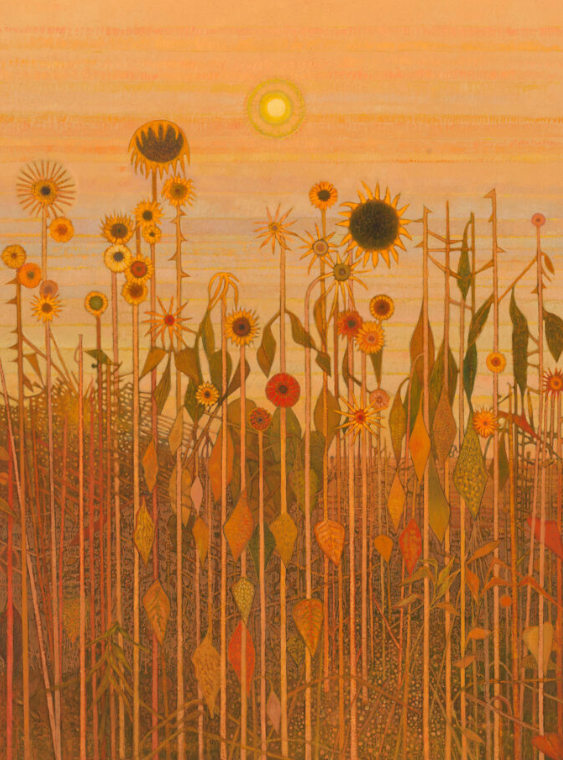
Followers, 2026
Oil and sand on canvas
244 x 183 cm (96 x 72 in)
© Sky Glabush
The exhibition anchors itself around large-scale paintings of great lakes, dense forests, fields of sunflowers and shifting vegetation, accompanied by a series of more intimate works. Glabush incorporates sand into his oil paint, building relief-like surfaces that catch and redirect light in ways that flat paint cannot, surfaces that ask to be felt as much as seen. Forms emerge from this textured ground as though surfacing from beneath it, half-recognised shapes that the eye assembles and then loses again – each work begins in observation and moves somewhere harder to name.
Glabush compares it to the evolution of a folktale, beginning with a common subject that functions as a kind of roadmap, then following the painting’s own internal logic as that architecture gradually breaks down and re-emerges in unexpected form. The image is discovered rather than planned. This is not the mystification of process that some painters reach for; it describes something specific about how sustained engagement with a subject produces results that the conscious mind could not have designed. The materials, as he describes it, have to guide the painting toward something that did not come from him.
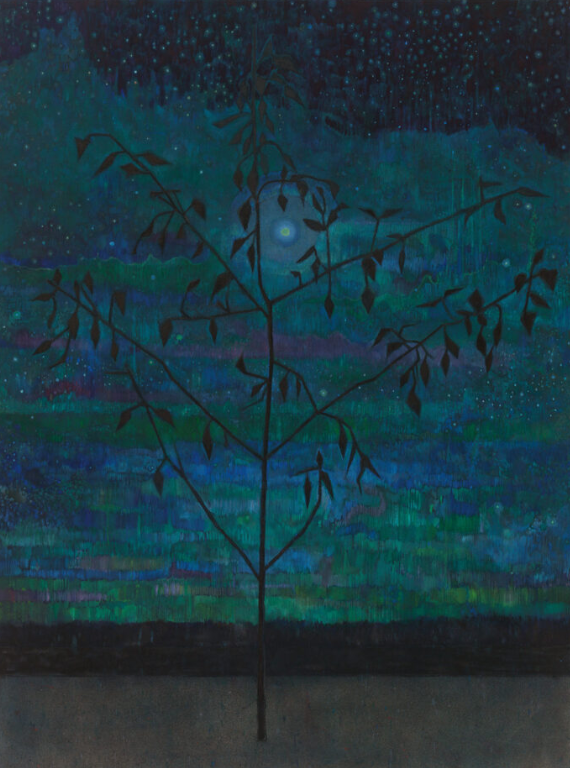
Apple tree with night sky, 2026
Oil and sand on canvas
244 x 183 cm (96 x 72 in)
© Sky Glabush
Poetry is the other sustaining influence. Ted Hughes, Seamus Heaney, Emily Dickinson and the Canadian poet Al Purdy all figure in Glabush’s reading. These are writers for whom landscape is not backdrop but a site of encounter with something that exceeds ordinary categorisation, where the natural world carries emotional and metaphysical weight without being reduced to symbol or allegory. Glabush’s paintings work in the same register: they are not illustrations of feeling, but spaces in which feeling becomes possible.
Living now in rural southwestern Ontario, Glabush works from the landscape immediately around him without being confined by it. Recent works move beyond any particular geography into something more universal, an invitation to slow down inside an image long enough for perception itself to become the subject.
Sky Glabush: If the Wild Bird Could Speak is at Alison Jacques, 22 Cork Street, London W1S 3NG, 20 November 2026 to 9 January 2027. Preview: Thursday 19 November, 6–8pm.
Oil and sand on canvas
213 x 274 cm (83 7/8 x 107 7/8 in)
© Sky Glabush courtesy Alison Jacques