Sam Jackson paints pictures of Queens, Princesses, and similar women of historical note. From Cleopatra to Boudicca to Queen Victoria, via Ann Boleyn, Catherine de Medici and Marie Antoinette, Jackson showers us with a multitude of portraits of various female dignitaries selected from the Western canon.
Apart from their sex, the one thing they have in common is that they cannot be painted from life.
These are creative conjurings of likeness, derived from secondary sources, folk tale and the artist’s imagination.
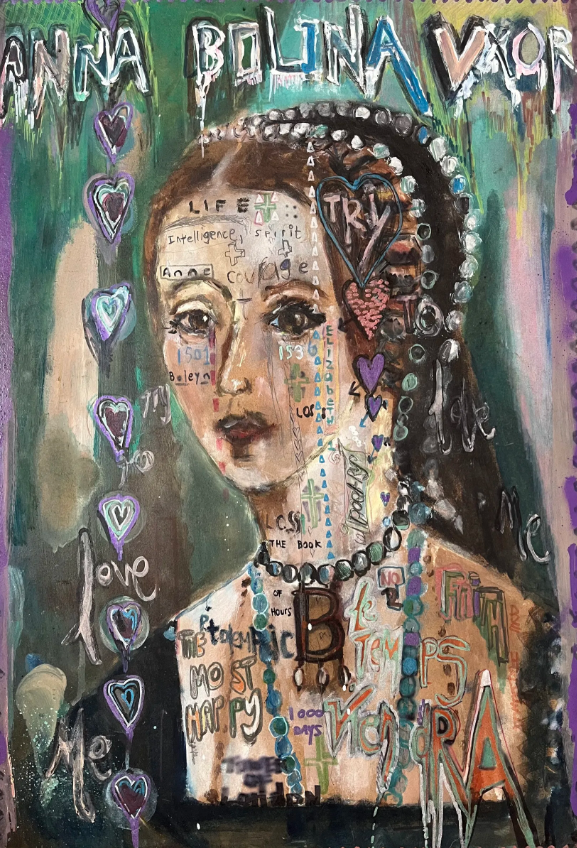
Anne Boleyn, 2026
Oil on Board
65 x 45 cm
25 5/8 x 17 3/4 in
History, as it has mostly been written, is not especially interested in what women looked like. We have no reliable portrait of Boudicca. Cleopatra’s face has been reconstructed from coins, speculation and centuries of wishful thinking. Anne Boleyn exists in a handful of disputed images, some of which were painted years after her execution. The historical record of powerful women is, in large part, a record of absence, distortion and projection. Sam Jackson’s exhibition at Pontone Gallery takes that absence as its subject and, rather than mourning it, paints directly into the gap.
The series brings together portraits of queens, princesses and women of historical consequence across centuries: Cleopatra and Boudicca alongside Catherine de Medici, Marie Antoinette, Queen Victoria and others drawn from the Western canon. The format is rigorous and consistent throughout, each work a head-and-shoulders composition that immediately invites comparison with the Kit Kat Club portraits of Godfrey Kneller, those seventeenth-century images of exclusively male luminaries — Newton, Vanbrugh, Congreve — painted to a fixed and deliberate formula as a record of their subjects’ consequence.
Jackson’s series operates as a pointed counterpart to that tradition, applying the same codifying logic to women the official portrait tradition largely overlooked, misrepresented or lost.
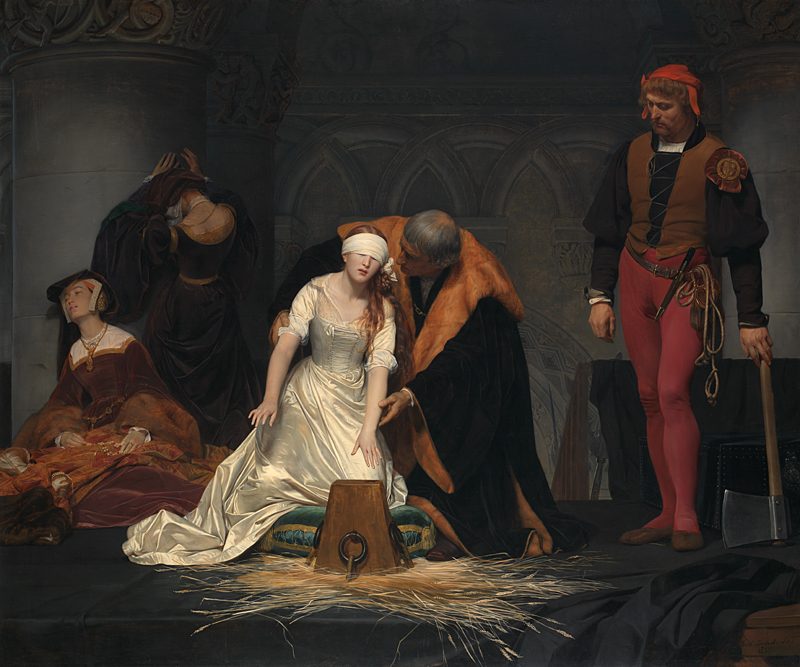
Paul Delaroche
The Execution of Lady Jane Grey
1833
Oil on canvas, 246 × 297 cm
Bequeathed by the Second Lord Cheylesmore, 1902
NG1909
https://www.nationalgallery.org.uk/paintings/NG1909
The contrast between Jackson’s Lady Jane Grey and Paul Delaroche’s celebrated 1833 rendering of her execution could hardly be more instructive. Delaroche’s painting is one of the great set pieces of academic history painting: Lady Jane blindfolded in white, kneeling in a posture of composed martyrdom, surrounded by figures who frame and witness her death with theatrical precision. It is a vision of female tragedy rendered for maximum emotional impact, the subject exquisitely passive at the centre of her own ending, her identity entirely consumed by the moment of her death. She is beautiful, she is tragic, and she is entirely legible.
Jackson’s portrait refuses all of that. His Lady Jane Grey is frontal, direct, and deliberately unresolved, words and fragments of text scattered across the surface, with Lady Jane Grey written across her face as though her name is part of the image rather than a label to be applied as an afterthought.
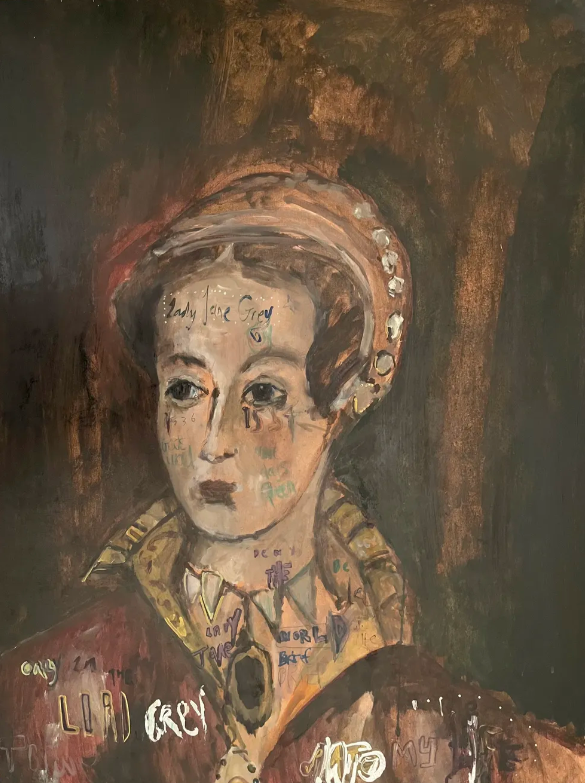
Lady Jane Grey, 2026
Oil on Board
80 x 60 cm
31 1/2 x 23 5/8 in
Where Delaroche gives us a woman at the defining moment of her victimhood, Jackson gives us a face that existed before the scaffold and persists in cultural memory beyond it. It claims only that she was there, that she mattered, and that the imagination is a legitimate tool for keeping her present. One painting tells you how she died; the other insists she lived.
Since these women cannot be painted from life, every image that has ever claimed to represent them is already an act of imagination, shaped by whoever held the brush and whatever they needed these women to be.
Jackson makes that imaginative mediation visible rather than disguising it behind the false confidence of historical portraiture. His Cleopatra and his Boudicca are openly invented, which makes them no less real as cultural presences and considerably more honest about how we actually know them: through story, myth, partial record and the weight of what has been said about them.
The subjects remain largely unknowable, and Jackson does not pretend otherwise. The faces carry an icon-like quality, remote and archetype-shaped, which reflects the truth of how these women have come down to us: not as full human beings with interior lives we can access, but as symbols onto which successive generations have projected their own needs and anxieties.
The pictorial iconography of regality and feminine power that Jackson explores is not his invention; it is what culture has made of these women in their absence, and he renders it with clear-eyed wit.
Taken together, the series asks a straightforward but pointed question: if history was going to invent these women anyway, who gets invent what remains – and on whose terms?
The exhibition opens November 5 – December 5 2026 at Pontone Gallery, London.
Header: