Julio Le Parc: Light, Colour, Action has opened at the Tate. The show was years in the making and developed with the artist’s close involvement, but it now arrives under very different circumstances than intended: Le Parc died in Paris on 30 May 2026, at the age of 97, only a fortnight or so before the doors were due to open. What was conceived as a celebration of a still-active nonagenarian has, almost overnight, become a memorial.
Born in Mendoza, Argentina in 1928, Le Parc moved to Paris in the late 1950s and quickly became a central figure in the city’s experimental art scene, eventually co-founding the Groupe de Recherche d’Art Visuel. The Tate retrospective gathers more than sixty works spanning the better part of seventy years, and the curatorial logic seems designed to make visitors feel the development of his ideas in real time rather than simply admire finished objects.
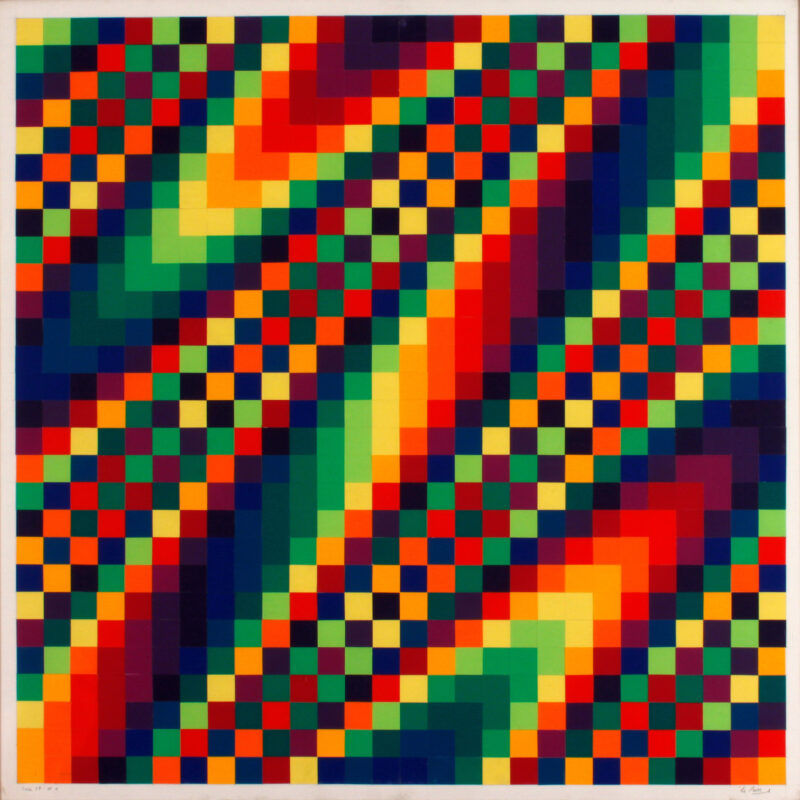
Julio Le Parc, Series 37 n°1, 1970. Lent by the Atelier Le Parc 2026 © ADAGP, Paris and DACS, London 2025.jpg
The earliest rooms focus on his black-and-white gouaches and paintings from the late 1950s, built from repeating geometric forms arranged according to mathematical rules so that the patterns appear to shimmer, rotate or pulse as you look at them. These works also play with the afterimage effect, where staring at a high-contrast shape leaves a ghost impression on the eye that lingers once you look away, effectively making the viewer’s own perception part of the artwork.
From the early 1960s onward, Le Parc pushed this further into three dimensions, introducing actual movement and light into reliefs and mobiles, then experimenting with projected and reflected light, and later with distorting mirrors that altered visitors’ sense of their own position in the room. This trajectory, towards making the audience an active participant rather than a passive observer, was unusual for its time and earned him international recognition early on, including a New York solo show and the top painting prize at the Venice Biennale in 1966.
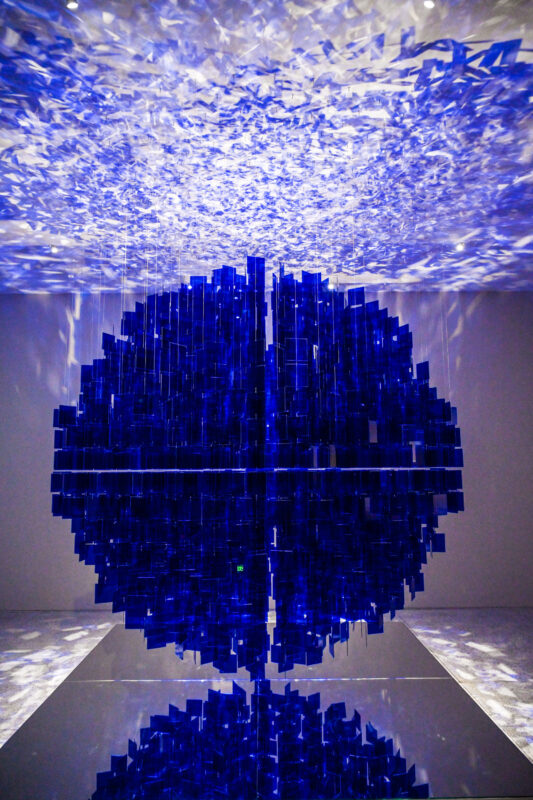
Julio Le Parc Blue Sphere 2013 Lent by the Tate Americas Foundation, courtesy of the Latin American Acquisitions Committee 2023 © ADAGP, Paris and DACS, London
The exhibition’s later sections bring the story up to date, including a sculptural piece called Blue Sphere that revisits the mirrored, kinetic ideas of his earlier mobiles in a more recent form. The show closes by returning to colour itself, tracing a fourteen-hue palette Le Parc devised back in 1959 through decades of variations, including his well-known wave-pattern paintings and later series exploring colour combinations and visual rhythm.
Taken as a whole, the exhibition makes the case for Le Parc as someone who spent his entire career trying to dismantle the idea that art is something you simply look at from a respectful distance. Whatever the Tate’s original framing for this show might have been, it now functions as both an introduction to that radical proposition for newer audiences and a fitting send-off for the man who spent seven decades putting it into practice.
Julio Le Parc: Light, Colour, Action is at Tate Modern, George Economou Gallery, from to 3 May 2027.