Rather than simply revisiting the well-worn mythology of Frida Kahlo — the flowers, the unibrow, the pain, the romance, the tragedy — Tate Modern’s latest exhibition, Making of an Icon, attempts to disentangle how an artist who died in relative obscurity became one of the most recognisable cultural figures on the planet.
In doing so, it proposes a subtle but important shift: Kahlo is no longer merely the subject of art history, but the architect of an entire visual and political language that continues to shape contemporary culture.
This distinction matters, because Kahlo, over the past few decades, has drifted into a strange territory somewhere between saint, meme and brand. Her image circulates so freely through fashion, advertising and social media that it can be difficult to recover the artist herself from beneath the avalanche of iconography.
Tate’s exhibition appears acutely aware of this tension. Rather than resisting the mythology, it interrogates it directly, tracing the mechanisms through which Kahlo’s carefully constructed self-image evolved into a global commodity.
The timing feels apt. Contemporary audiences are perhaps equipped more than ever to understand Kahlo’s unique practice as one rooted in performance, self-fashioning and identity construction.
Long before Instagram transformed selfhood into a form of public authorship, Kahlo understood the political and aesthetic power of curating the self. Her portraits were never simple acts of representation; they were declarations. Each painting became a negotiation between personal suffering, national identity, gender politics and artistic invention.
The exhibition’s opening section will focus on this process of self-construction, bringing together early and rarely seen self-portraits alongside personal belongings and archival material. Self-Portrait (With Velvet Dress) from 1926 and Self-Portrait with Loose Hair from 1938 offer a reminder of Kahlo’s remarkable ability to manipulate image and symbolism with forensic precision.
These works are not merely autobiographical. They are theatrical, coded and deeply strategic. Kahlo presents herself variously as romantic heroine, wounded martyr, political radical and androgynous provocateur. What Tate seems particularly interested in foregrounding is the multiplicity of these identities, and the degree to which Kahlo anticipated many contemporary conversations around fluidity, embodiment and representation.
Positioning these paintings alongside figures associated with the Mexican Renaissance, including Diego Rivera and María Izquierdo, is also a welcome corrective. Kahlo is often isolated from her artistic context, flattened into singular genius or biographical curiosity. Here, the exhibition restores the creative networks and intellectual exchanges that shaped her work. Rivera’s portrait of Kahlo becomes especially fascinating in this light: less a depiction of an artist’s wife than an image of a cultural force in formation.
Yet it is in the exhibition’s treatment of surrealism that the show may prove most compelling. Kahlo’s relationship with the movement has always been uneasy. André Breton’s famous description of her as “a self-made Surrealist” simultaneously elevated and misunderstood her work. Kahlo herself rejected the label outright, insisting she painted reality, not dreams. Tate wisely resists forcing a definitive categorisation. Instead, it explores the affinities between Kahlo and her surrealist contemporaries through shared motifs — masks, death, fractured bodies and dream imagery — while allowing important distinctions to remain unresolved.
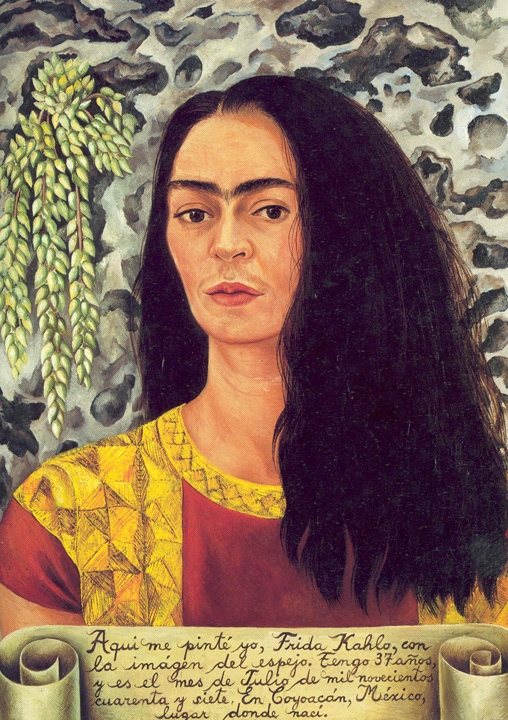
Self-Portrait with Loose Hair
Works such as Memory (The Heart) and Girl with a Death Mask reveal just how unsettling Kahlo’s vision could be. Removed from the sanitised familiarity of reproductions and merchandise, these paintings regain their psychic violence. Her imagery is often genuinely disturbing: exposed organs, tears transformed into objects, bodies split apart or fused with landscape. Seen in dialogue with artists like Leonor Fini and Kati Horna, Kahlo emerges not as an isolated eccentric but as part of a broader international fascination with the subconscious, mortality and transformation during the interwar years.
Perhaps the exhibition’s most significant contribution, however, lies in its examination of Kahlo’s afterlife. The show traces how her image was reclaimed during the Chicana/o movement of the 1960s and 70s, when Mexican-American artists and activists embraced her as a symbol of resistance and cultural pride. This chapter feels especially resonant today, when debates around migration, nationalism and identity remain politically charged. Kahlo’s ambivalence towards the United States — vividly articulated in My Dress Hangs There — acquires renewed contemporary relevance in this context.
Importantly, Tate does not present Kahlo’s influence as passive admiration. The artists included throughout the exhibition actively transform and complicate her legacy. Figures such as Nahúm B. Zenil and Georgina Quintana repurpose Mexican iconography to critique machismo and nationalism, while later artists including Ana Mendieta, Judy Chicago and Kiki Smith expand Kahlo’s investigations into gender, violence and bodily autonomy. The exhibition seems less interested in tracing stylistic imitation than in mapping an evolving set of political and emotional concerns that Kahlo helped legitimise within art.
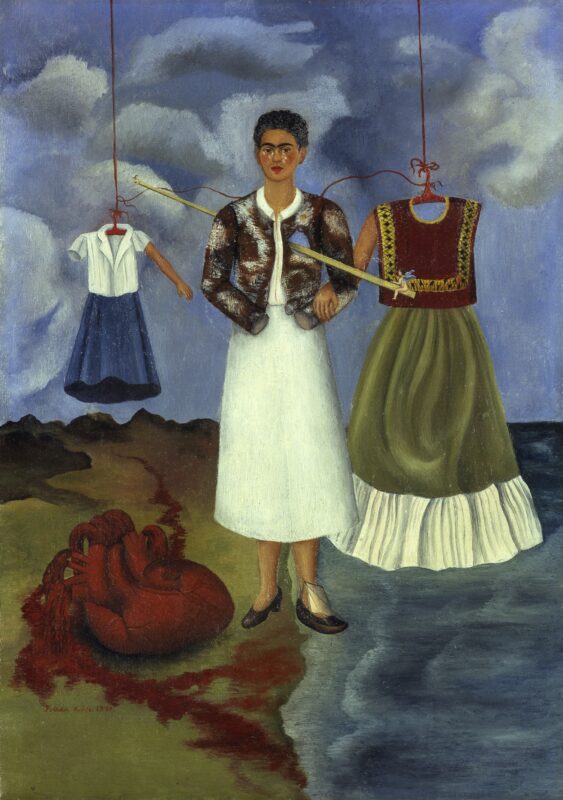
CH343491 Recuerdo, 1937 (oil on canvas) by Kahlo, Frida (1907-54); 40×28.3 cm; Private Collection; Christie’s Images.
This approach also allows the exhibition to address one of the central paradoxes of Kahlo’s contemporary popularity: the tension between radicalism and commodification. Kahlo’s image now exists everywhere, often detached entirely from her politics or artistic practice. The final section, dedicated to “Fridamania”, could easily have descended into cynicism, but instead appears to frame this commercial explosion as part of the exhibition’s broader argument about image-making and cultural consumption.
The accumulation of more than 200 branded objects — tequila bottles, Barbie dolls, perfume, T-shirts — promises to be both absurd and oddly moving. It illustrates how thoroughly Kahlo’s face has entered global visual culture, while also raising uncomfortable questions about the market’s ability to absorb dissent and transform it into lifestyle branding. That contradiction feels central to understanding Kahlo’s endurance. She represents rebellion, suffering and authenticity, but also functions as an endlessly reproducible aesthetic product.
What emerges from Tate Modern’s exhibition is not a definitive portrait of Frida Kahlo, but something more interesting: a study of how cultural icons are manufactured, circulated and continually reinvented. The exhibition recognises that Kahlo’s meaning has never been fixed. She belongs simultaneously to feminist art history, queer politics, Mexican nationalism, disability discourse, fashion imagery and consumer capitalism. Few artists have occupied so many symbolic positions at once.
There is also a refreshing sense that Tate understands the risks of over-familiarity. Kahlo’s ubiquity can sometimes dull the strangeness and severity of her work. By situating her paintings within wider artistic, political and cultural histories, Frida: The Making of an Icon seems determined to restore some of that complexity. The result promises not simply another blockbuster retrospective, but a meditation on how artists become myths — and what is lost, gained and transformed in the process.
Now booking, the exhibition runs from 25 June – 3 January 2027
All images courtesy of Tate press office