 By Beverly Kern
Icheon and Beyond: The Space Within Form
At the Korean Cultural Centre UK in London, a new exhibition opening as part of London Craft Week turns its attention to one of Korea’s most historically resonant craft traditions.
Icheon and Beyond: The Space Within Form is framed as a meditation on endurance, but it is equally a study in translation – how the disciplined language of ceramics, shaped over centuries in Icheon, continues to evolve in contemporary hands.
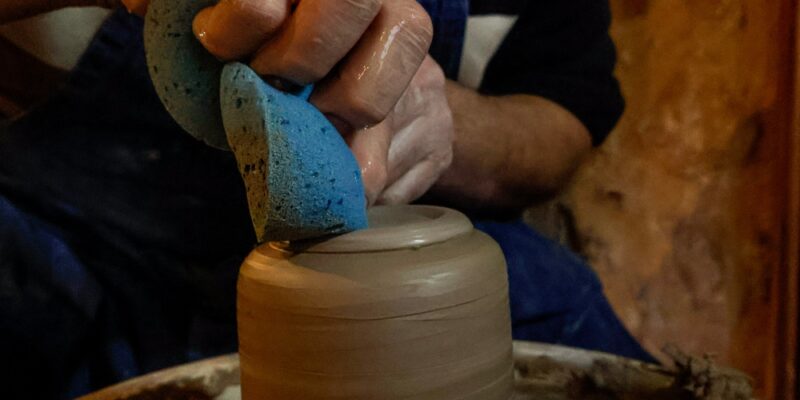
Icheon occupies a near-mythic position within Korean ceramic history. Renowned for its high-quality clay and kiln culture, the region has been central to the development of Korean pottery since the Goryeo and Joseon dynasties, when celadon and later buncheong and white porcelain reached technical and aesthetic refinement. Today, it remains a living centre of production, home to master artisans who sustain techniques that are as much embodied knowledge as they are formal skill. The exhibition’s first movement, bringing together 21 such master artisans, positions their work not simply as heritage objects but as accumulations of time – forms shaped by repetition, discipline and generational continuity.
The language of these works is one of restraint. Vessels appear deceptively simple: pale porcelain surfaces, balanced silhouettes, glazes that hold light rather than reflect it. Yet this apparent stillness is the result of rigorous control. Korean ceramics have long privileged what might be described as “quiet virtuosity” – a sensitivity to proportion, tactility and negative space that resists overt display. In this sense, The Space Within Form is an apt subtitle. Emptiness is not absence here, but structure: the interior volume of a vessel becomes as significant as its exterior contour.
The exhibition gains conceptual momentum in its second half, where six contemporary artists – including Seyeon Cho, Ingkyu Choi and Mimi Joung – extend and complicate this inheritance. If the masters’ works are anchored in continuity, these newer practices introduce fracture, expansion and play. Sculptural forms stretch, collapse or fragment; traditional glazing techniques are recontextualised; the vessel itself is sometimes abandoned altogether.
This intergenerational juxtaposition reflects broader shifts within contemporary Korean craft, where the boundary between functional object and sculptural artwork has become increasingly porous. In recent decades, artists working with clay have moved beyond strict adherence to tradition, engaging instead with installation, conceptual art and global contemporary discourse. Yet what distinguishes many of these practices is their continued dialogue with material memory. Even at their most experimental, the works retain an awareness of the discipline from which they emerge.
There is also a subtle cultural translation at play in staging this exhibition in London. As Korean culture continues to gain international visibility – from visual art to cinema and design – craft traditions risk being either romanticised or flattened into aesthetic signifiers. Icheon and Beyond resists this by foregrounding process and temporality. The emphasis on “sedimented time” is not merely poetic; it points to the labour conditions and philosophical frameworks underpinning these objects. Clay, here, is not just a medium but a record of duration: of seasons, firing cycles, and accumulated gestures.
The partnership with London Craft Week reinforces this positioning. Over the past decade, the festival has increasingly expanded its scope beyond Eurocentric narratives, creating space for global craft dialogues that challenge conventional hierarchies between art, design and making. Within this context, the exhibition reads as both an introduction and a corrective: an invitation to engage with Korean ceramics not as static tradition, but as a dynamic, evolving field.
Curatorially, the exhibition’s strength lies in its pacing. The transition from the “deep stillness” of the master artisans to the “vibrant rhythms” of contemporary practice is not abrupt but gradual, allowing viewers to register continuities as well as divergences. Formal echoes – curves, surfaces, gestures – reappear across generations, suggesting that innovation here is less about rupture than about rearticulation.
Ultimately, Icheon and Beyond: The Space Within Form is less concerned with presenting definitive answers than with staging a conversation across time. It asks how knowledge is carried forward, how forms endure through adaptation, and how silence—so central to the tradition of Korean ceramics—can continue to speak within a contemporary visual language.
In an art world often driven by novelty, this exhibition offers a different proposition: that innovation may lie not in abandoning the past, but in returning to it with sustained attention.
March 27 – June 5