Edinburgh-based painter and tattoo artist Sarah Muirhead has built a reputation for work that moves fluidly between the intensely personal and the archetypal.
Known for psychologically charged portraits steeped in symbolism and rendered with meticulous technical control, Muirhead’s practice interrogates identity, desire and memory through images that feel at once diaristic and mythic. Her latest exhibition deepens these concerns, bringing together a new body of paintings and a suite of sketchbook drawings made during a period of enforced physical stillness.
Muirhead, who maintains a parallel career as a tattooist, brings to her canvas the same precision and sensitivity to skin that have defined her tattoo practice. Across both disciplines, the body becomes a site of inscription: marked by longing, fantasy, grief and projection. Working predominantly from people within her immediate circle, she constructs portraits that resist straightforward likeness. Faces and gestures are often suspended in ambiguous space, charged with symbolic objects or doubled through compositional echoes. The result is a visual language that feels devotional yet unsettled, rooted in lived relationships but reaching toward something more universal.
The new drawings in this exhibition emerged from a moment of interruption. Confined to her flat following a knee injury, Muirhead turned to works on paper out of practical necessity. What began as a solution to limited mobility quickly evolved into a compulsive, almost meditative practice. Drawing, here, is not a preparatory step toward painting but a discrete mode of thinking. Working from her own photographs, she assembles intuitive mental collages, layering remembered fragments into compressed, private worlds that feel illogical and intensely focused.
These sketchbook works reveal an artist grappling with frustration and desire under conditions of physical constraint. The slowed body produces accelerated interiority: images loop, overlap and return in altered forms. Memory in these drawings is unstable, prone to distortion and embellishment. Figures appear half-remembered; gestures repeat with subtle shifts in emphasis; symbolic motifs accrue new meanings through iteration. The effect is both claustrophobic and clarifying, as though the limits of the room have sharpened the terrain of the mind.
Seen alongside the new paintings, the drawings complicate and sharpen the exhibition’s central concerns. Muirhead has long been interested in what survives after an encounter; how intimacy lingers as residue or phantom. An earlier presentation in August posed the question of what remains once something is gone. This second chapter pivots toward repetition: what happens when we return, again and again, to the same image, the same face, the same ghost?
In the paintings, repetition becomes an act of care. Layers are built up slowly, surfaces reworked until colour and gesture achieve a fragile equilibrium. Muirhead’s palette – often moody, with passages of deep shadow punctured by luminous skin tones – intensifies the emotional tenor of the works. The figures are neither wholly present nor absent; they hover in states of becoming, shaped as much by recollection as by observation.
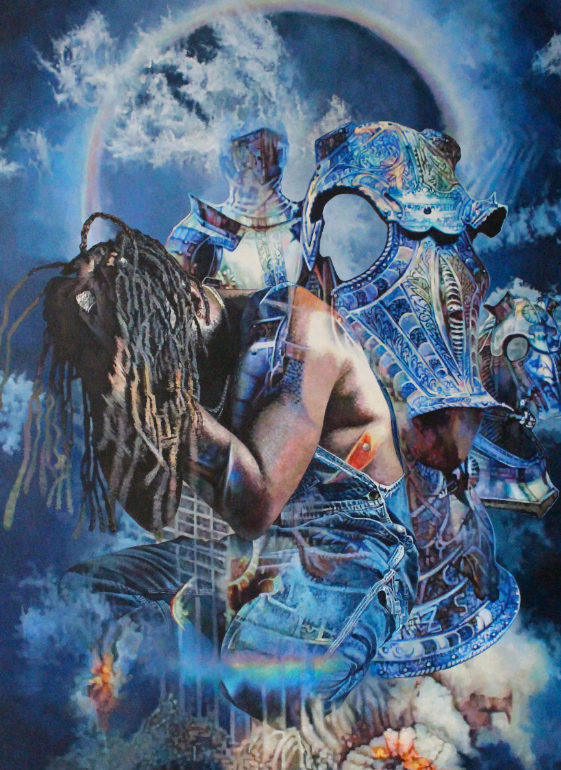
The dialogue between painting and drawing also underscores the exhibition’s meditation on time. The sketchbooks carry the immediacy of daily return, each page a record of persistence. The paintings, by contrast, feel suspended, time thickened and held. Together, they trace a movement from compulsion to contemplation, from the restless accumulation of images to their careful distillation.
For Muirhead, whose practice has cultivated a devoted following both within and beyond Scotland, this exhibition marks a subtle but significant shift. By foregrounding drawing as an end in itself, she exposes the scaffolding of her visual language and invites viewers closer to its vulnerabilities. The works suggest that repetition is not simply a symptom of fixation but a method of survival: a way of tending to memory, of testing its contours, of insisting that certain images – however unstable – remain.
In returning to her own archive of photographs and experiences, Muirhead does not seek resolution. Instead, she embraces the recursive nature of desire and remembrance. The exhibition ultimately proposes that what endures is not the moment itself, but the act of revisiting it – the quiet, stubborn labour of looking again.
A Ghost Only You Can Name (Pt 2) is at Pontone Gallery from February 12 – March 14
All images courtesy the artist and Pontone Galler